As third‑party cookies disappear and Apple’s ATT limits mobile tracking, marketers across the GCC are scrambling for reliable signals. In the UAE, the shift is not just technical, it is mandated by the Federal Decree‑Law No. 45 of 2021 (PDPL), which places explicit consent at the heart of any electronic marketing activity.
This article explains how to pivot from fragile third‑party identifiers to a resilient, first‑party ecosystem built on Customer Data Platforms (CDPs) and CRM‑driven automation. You will discover the legal foundations, the technical stack, and the practical steps required to keep attribution accurate while honouring regional privacy obligations.
By the end of the guide, you will have a ready‑to‑implement blueprint that aligns with the UAE PDPL, the DIFC and ADGM data regimes, and the broader GCC privacy landscape.
Regulatory Landscape & Consent Foundations
The UAE’s Personal Data Protection Law (PDPL) establishes a consent‑first regime for all electronic marketing and profiling activities. Unlike the GDPR, the PDPL does not permit “legitimate interest” as a blanket justification; explicit, informed opt‑in is required before any personal identifier can be processed for advertising purposes.1
Key Articles that Matter to Marketers
- Article 5 & 6: Consent must be clear, specific, and separate from other terms of service.
- Article 22 & 23: Cross‑border transfers are allowed only to jurisdictions with adequate protection, via SCCs or explicit consent.
Free zones such as DIFC and ADGM operate under GDPR‑style regulations, demanding rapid breach notifications (24‑72 hours) and robust data‑subject access rights.2 For GCC‑wide campaigns, Saudi Arabia’s PDPL imposes similar consent and transfer requirements, meaning a single regional strategy must satisfy multiple legal regimes.3
⚠️ Common Mistakes to Avoid
- Pre‑ticked boxes: Considered non‑compliant under Article 5; users must actively opt‑in.
- Sending raw PII to third‑party ad servers: Even hashed data is still personal data under the PDPL and requires consent and appropriate transfer safeguards.
Takeaway: Deploy a Consent Management Platform (CMP) that records granular opt‑in choices and integrates directly with your CDP to enforce consent at the data‑layer level.
Server‑Side Tracking & Identity Resolution
With browser‑based pixels losing up to 35‑45 % of signals in high‑iOS markets, server‑to‑server (S2S) measurement has become the backbone of reliable attribution.4 Platforms such as Meta’s Conversions API, Google’s Enhanced Conversions, and TikTok’s Events API now expect hashed first‑party identifiers (email, phone, external IDs) to match users back to ad impressions.
Why Server‑Side Beats Client‑Side
- Bypasses ad‑blockers and Safari ITP.
- Allows data sanitisation before it leaves the UAE, keeping it within regional cloud zones (e.g., AWS Bahrain, Google Cloud Dammam).
- Facilitates deduplication through a shared
event_idacross client and server streams.
Implementation Blueprint
- Set up a server‑side Google Tag Manager container hosted in a UAE‑based cloud region.
- Map CMP consent signals to GTM variables; only fire CAPI events when advertising consent is true.
- Hash required fields with SHA‑256 (e.g.,
email→em,phonewith+971prefix →ph). - Configure event deduplication logic to avoid double‑counting between client‑side and server‑side hits.
| Factor | Client‑Side Tracking | Server‑Side Tracking |
|---|---|---|
| Signal Loss (iOS) | 35‑45 % | 5‑10 % |
| Compliance Control | Limited | Granular (via CMP) |
| Data Residency | Often US‑based | UAE‑regional clouds possible |
Note: Data compiled from industry sources. Actual results vary.
Takeaway: Pair server‑side GTM with a regional cloud instance and feed only consent‑approved, hashed identifiers into platform APIs.
Building the Owned First‑Party Funnel
Once consent is secured and measurement is reliable, the next step is to funnel the audience through owned channels, email, WhatsApp, and in‑app messaging, while still feeding high‑quality lookalike audiences to paid media.
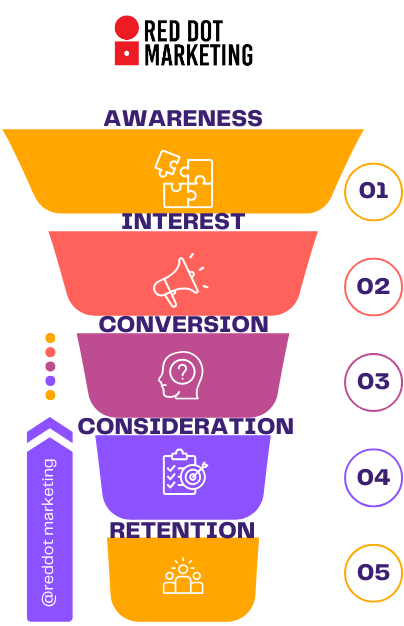
Step‑by‑Step Funnel Architecture
- Acquisition Layer: Drive traffic via SEO, paid search, and contextual display. Capture zero‑party data through interactive quizzes, style surveys, or checkout forms.
- Consent Orchestration: Route the visitor to a CMP that records explicit advertising consent before any identifier is stored.
- CDP Consolidation: Ingest web, app, and POS data into a unified CDP (e.g., HubSpot Enterprise, Segment, or Tealium). Resolve a single customer ID that links email, phone, and device IDs.
- Zero‑Party Enrichment: Use short‑form surveys to collect preferences, size, or travel intent. Store these as custom attributes for hyper‑personalisation.
- Owned Activation: Trigger automated WhatsApp Business and bilingual email flows (welcome, cart abandonment, post‑purchase). In the UAE, WhatsApp open rates routinely exceed 80 % compared with 15‑20 % for email alone.5
- Paid Lookalikes: Export hashed high‑value segments (e.g., top 10 % LTV) to Meta and Google via CAPI. Ensure suppression lists sync back in real time to respect opt‑out requests (Article 8 PDPL).
Data‑Clean‑Room Partnerships
For large retailers or travel brands that need to collaborate with publishers, adopt a clean‑room solution (Snowflake, InfoSum, or Amazon Clean Rooms). This enables audience matching without exposing raw PII, satisfying both UAE and Saudi cross‑border rules.6
Takeaway: Prioritise phone capture and WhatsApp automation for the GCC market; it delivers higher engagement and stays within the consent‑first framework.
Agency Checklist & Best Practices
To operationalise the first‑party pivot at scale, agencies should adopt a systematic checklist that aligns legal, technical, and creative workflows.
Compliance Checklist
- Update all Master Services Agreements (MSAs) and Data Processing Agreements (DPAs) to reference Federal Decree‑Law No. 45 of 2021.7
- Audit every third‑party tag for undisclosed personal identifiers; block any that fire before advertising consent.
- Document cross‑border transfer mechanisms (SCCs, explicit consent, or adequacy decisions) for any cloud service outside the UAE.8
Technical Migration Checklist
- Identify all client‑side pixels; replace with server‑side GTM containers hosted in UAE regions.
- Configure Meta, Google, and TikTok CAPI endpoints with hashed
email,phone, andexternal_idfields. - Implement event deduplication using a shared
event_idgenerated at the CDP layer.
Creative & Activation Checklist
- Design bilingual consent banners that separate functional, analytics, and advertising toggles.
- Build zero‑party quiz templates that feed directly into the CDP via API.
- Set up automated WhatsApp and email nurture streams that respect the latest opt‑in status.
Takeaway: Treat consent as a data‑pipeline gate, if the flag is false, the record never leaves the CMP.
Frequently Asked Questions
What is the difference between first‑party and zero‑party data?
First‑party data is any information a brand collects directly from its audience (e.g., website visits, purchase history). Zero‑party data is voluntarily provided by the user, such as quiz answers or preference selections, and is inherently consent‑driven.
Do hashed email addresses still count as personal data under the UAE PDPL?
Yes. The PDPL treats pseudonymised data (including SHA‑256 hashes) as personal data, so explicit consent and appropriate transfer safeguards remain required.
Can I host my server‑side GTM container outside the UAE?
You can, but you must ensure the destination jurisdiction provides an adequacy level comparable to the UAE or obtain binding SCCs and explicit user consent for the transfer.
How do I create lookalike audiences without violating PDPL?
Export only hashed identifiers of consented high‑value segments via CAPI, and let the ad platform perform the matching internally. Always sync opt‑out lists back to your CDP to honour the right‑to‑be‑forgotten.
Is a Consent Management Platform mandatory in the UAE?
While not explicitly required, a CMP provides the technical means to capture, store, and demonstrate the explicit consent demanded by Article 5 of the PDPL, and it simplifies compliance audits.
🎯 Key Takeaways
- Secure explicit, bilingual consent before any advertising identifier is processed.
- Replace client‑side pixels with server‑side GTM and CAPI to recover lost conversion signals.
- Use a CDP to unify web, app, and POS data, and enrich profiles with zero‑party inputs.
- Leverage WhatsApp Business for high‑engagement owned retargeting in the GCC.
- Maintain up‑to‑date DPAs and cross‑border transfer safeguards for any data leaving the UAE.
Sources & References
- China‑Briefing - UAE Data Protection Obligations and Cross‑Border Transfer, 2024
- Chambers - Data Protection & Privacy Trends 2026, UAE
- U.S. Trade.gov - Cross‑Border Data Flows in the UAE, 2024
- DataGuidance - United Arab Emirates Data Protection Overview, 2025
- Incept Legal - Cross‑Border Data Protection Compliance, 2024
- U.AE - UAE Data Protection Laws, 2023
- IABMENA - MENA Digital Ad Spend Report 2025‑2026
- CampaignME - Digital Ad Spend in MENA Reaches $8B, 2025
- Altman Solon - State of Digital Advertising in MENA, 2025
- UAE Legislation - Federal Decree‑Law No. 45 of 2021 (PDPL)
Methodology: This article synthesizes information from industry reports, platform documentation, and our agency's direct experience managing digital campaigns in the UAE and GCC region.
Ready to Future‑Proof Your Marketing Funnel?
Red Dot Marketing can design a compliant, first‑party data architecture that drives measurable ROI in the UAE and GCC.
Get Free ConsultationLast reviewed: October 2026. This article is regularly updated to reflect the latest industry developments and platform changes.