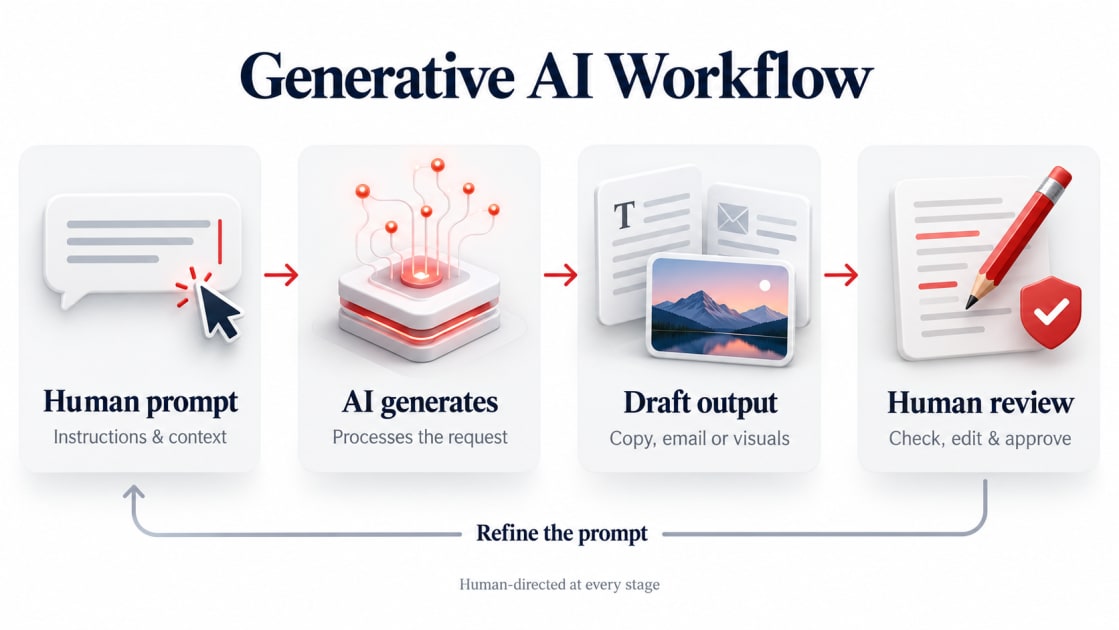
Over recent years, organisations worldwide, including throughout the UAE, have predominantly engaged with artificial intelligence as on-demand creative assistants. Users would input detailed prompts into chat interfaces, await a short processing period, and receive outputs such as drafted social media captions, translated emails, or initial visual concepts. This interaction model characterised the initial phase of Generative AI: reactive, limited to isolated prompts, and entirely dependent on human supervision at every stage.
Agentic AI marks a profound shift in software architecture, transcending the passive, prompt-driven nature of traditional generative systems. Instead of waiting for step-by-step instructions, an AI agent functions as an autonomous digital operator assigned a strategic commercial goal. It continuously assesses its environment, formulates sequential plans, integrates multiple digital tools, monitors campaign performance, self-corrects upon encountering challenges, and strives towards quantifiable business outcomes.
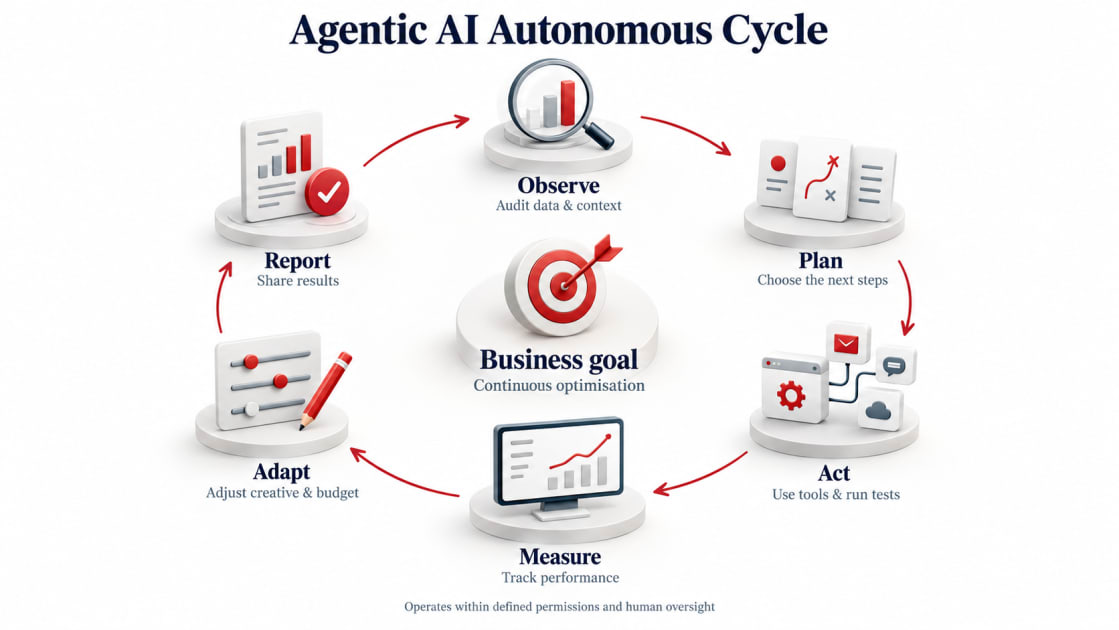
To elucidate this transformation: Generative AI resembles an assistant drafting a memo when instructed precisely what sentences to write. In contrast, Agentic AI acts like an experienced growth marketing manager who is given a target—such as reducing customer acquisition cost by 15% across digital channels—and autonomously audits analytics, tests creative variations, reallocates budget, and reports results. This comprehensive guide explores Agentic AI's definition, its four-pillar architecture, enterprise data insights, and the key beneficiaries of its deployment.
What Is Agentic AI? The Core Difference
Agentic AI systems integrate large language models (LLMs) with advanced reasoning mechanisms, persistent long-term memory, and seamless tool integrations via APIs. These capabilities enable them to pursue complex objectives independently within dynamic operational contexts. Unlike traditional generative AI, which produces static, one-off content in response to specific prompts, agentic AI actively makes decisions and executes multi-step workflows across connected platforms.
| Dimension | Generative AI | Agentic AI |
|---|---|---|
| Operational Trigger | Specific user prompt | High-level objective or environmental trigger |
| Workflow Scope | Single prompt to single output | Iterative planning to multi-step execution |
| Tool Usage | Confined to chat interface | Connects to APIs, CRMs, ad platforms, and databases |
| Error Handling | Produces plausible errors; requires human review | Evaluates output against targets and self-corrects |
| Autonomy Level | Assisted (Level 1) | Goal-directed semi to high autonomy (Levels 3 to 5) |
Note: Data compiled from industry sources. Actual results may vary depending on integration and configuration.
Consider a typical marketing scenario: a strategist uses Generative AI to craft five headline variants. An Agentic AI system, however, could autonomously draft these headlines, deploy them via the Meta Ads API, analyse click-through rates segmented by demographics, shift budgets towards the best performers in real-time, and archive these insights to inform future campaigns.
How It Works: The 4-Pillar Autonomous Engine
Agentic AI systems operate through an iterative decision loop underpinned by four foundational pillars: Perception, Reasoning, Action, and Reflection. This framework allows the agent to function as an intelligent autonomous operator, continuously adapting to evolving conditions.
The Autonomous Agent Decision Loop
1. Perception
Continuously ingests real-time data streams: website analytics, CRM updates, ad spend metrics, and platform-specific insights.

2. Reasoning
Decomposes overarching objectives into structured sub-tasks using advanced cognitive frameworks like ReAct or Chain-of-Thought.
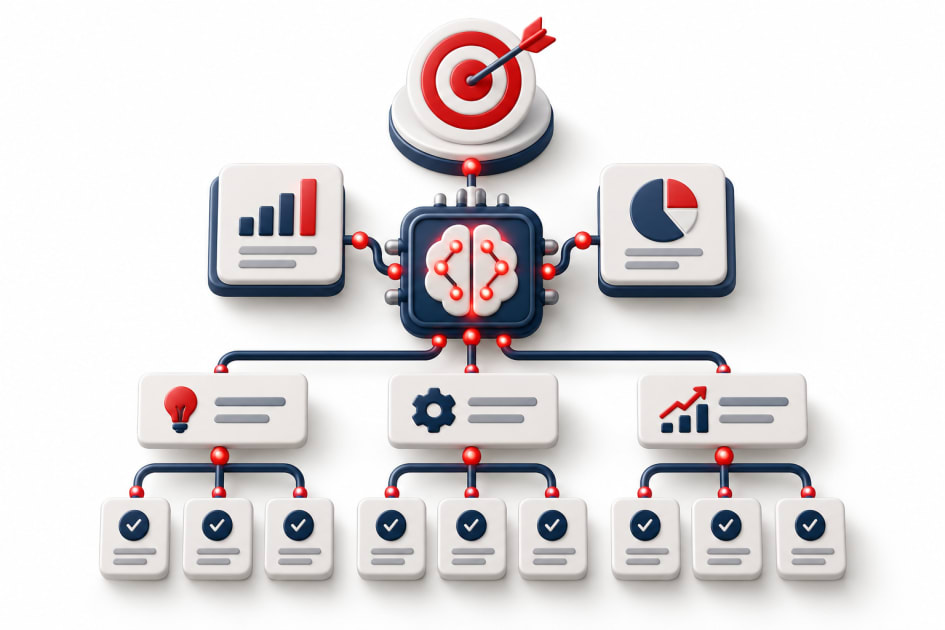
3. Action
Executes planned tasks by invoking external APIs—scheduling posts, adjusting bids, generating creative assets, and sending notifications.

4. Reflection
Evaluates outcomes against KPIs, identifies deviations, self-corrects errors, and archives learnings to improve future cycles.

1. Perception: Understanding the Context
Agentic AI continuously monitors the operational environment by connecting directly to data streams such as Google Analytics 4, TikTok Ads Manager, or enterprise inventory databases. This real-time data ingestion enables it to maintain situational awareness without manual input.
2. Reasoning and Planning: Deciding What to Do
Upon receiving a high-level objective, the agent formulates a sequential execution plan. For instance, if tasked with launching a seasonal campaign across the UAE, it evaluates stock levels, reviews prior campaign benchmarks, segments target audiences, and generates creative briefs accordingly.
3. Action and Tool Calling: Interacting with the Real World
Action differentiates Agentic AI from traditional generative models. Through API integrations, the agent performs programmatic operations such as updating HubSpot CRM records, publishing carousels on Instagram, or generating region-specific copy variations tailored to local consumer behaviours.
4. Reflection and Self-Correction: Continuous Refinement
When an API call fails or an ad variation underperforms, the agent detects the anomaly, reviews its reasoning path, adjusts targeting criteria, and reallocates budget accordingly—without human intervention.
The Rise of the Agentic Economy: Industry Data
Enterprise technology is rapidly transitioning from passive interfaces to autonomous, goal-directed software agents. Recent authoritative research confirms the accelerating adoption of this paradigm worldwide.
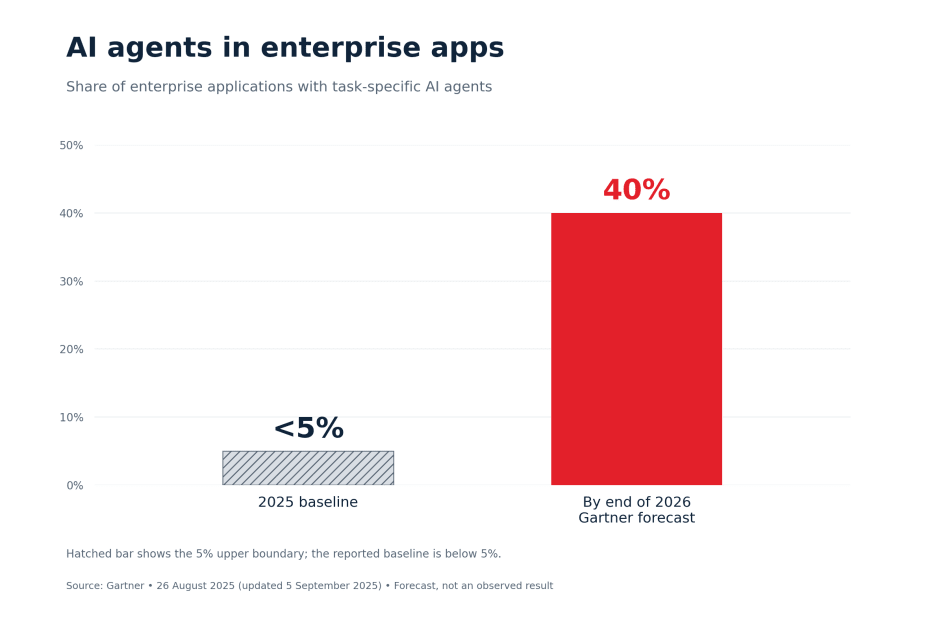
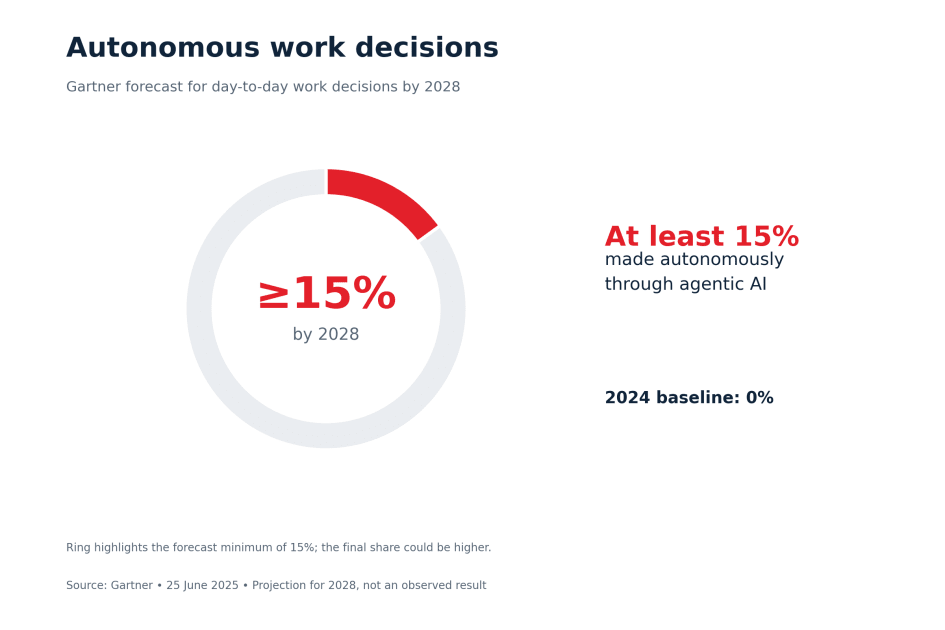
Several industry reports illustrate this accelerating trend:
- According to Gartner, 40% of enterprise applications will incorporate task-specific AI agents by 2026, a steep rise from under 5% in 2025.
- Further projections from Gartner via WFTV estimate that by 2028, 15% of operational work decisions will be autonomously executed by agentic software.
- A Capgemini Research Institute report reveals that 93% of business leaders believe scaling AI agents will confer a distinct competitive advantage, with estimated economic value generation reaching $450 billion by 2028.
- Insights from Capgemini highlight a paradigm shift from reactive customer service to proactive, resolution-driven experiences powered by agentic workflows.
Why Dubai and the GCC Lead Agentic Adoption
Although the foundational technologies are global, the GCC—and Dubai in particular—exhibits an accelerated adoption curve. This is driven by visionary government initiatives and forward-thinking economic strategies, positioning the UAE as a regional hub for autonomous business workflows.
1. The Dubai Universal Blueprint for Artificial Intelligence (DUB.AI)
Led by Dubai’s visionary leadership and aligned with the Dubai Economic Agenda D33, the Dubai Universal Blueprint for Artificial Intelligence (DUB.AI) integrates AI as a core driver of economic growth. As reported by Middle East AI News, Dubai has appointed Chief AI Officers across government entities to foster an ecosystem embracing automated, data-driven execution in commerce and public services.
2. Bilingual Nuances and Multi-Channel Demands
Operating a digital brand in the GCC necessitates addressing culturally diverse audiences. Marketing teams frequently manage bilingual campaigns across English and multiple Arabic dialects—including Gulf, Levantine, and Egyptian. Agentic AI workflows enable brands to synchronise culturally nuanced messaging across platforms such as Instagram, Snapchat, and LinkedIn, maintaining consistency and relevance without overburdening internal teams.

Who Benefits? Real-World Marketing and Enterprise Use Cases
Agentic AI’s utility extends well beyond software development teams. Its practical applications span disciplines where multi-step execution and continuous optimisation drive commercial success.
1. Chief Marketing Officers and Digital Growth Teams
Performance marketing teams often spend significant time on operational tasks like data extraction, attribution reconciliation, and manual budget reallocations. Agentic AI platforms automate these workflows:
- Cross-Platform Budget Rebalancing: Dynamically reallocates spend to top-performing assets across Google Ads, TikTok, and Meta platforms.
- Dynamic Creative Testing: Generates multiple ad variants, monitors early engagement metrics, and automatically disables underperforming creatives.
- Audience Segmentation: Continuously adjusts lookalike audiences based on recent CRM conversion data.
2. Regional E-Commerce Retailers
Retailers managing seasonal stock fluctuations—such as White Friday, Ramadan, and Eid—benefit from agents that tie marketing directly to supply chain data:
- Inventory-Driven Campaigns: Automatically increases ad spend on overstocked SKUs to optimise turnover.
- Abandoned Cart Recovery: Generates personalised, timely recovery messages across WhatsApp and email, driven by customer behaviour analytics.
3. High-Growth B2B Enterprises
In B2B sales, speed to lead is crucial. Agentic AI evaluates incoming inquiries, enriches firmographic data via public directories, scores lead quality, and coordinates meeting scheduling—reducing response times from hours to minutes.
Discover case studies demonstrating these transformations in the Gulf region at reddot.marketing/casestudies/.
⚠️ Common Mistakes to Avoid
- Deploying Agents Without Clear Guardrails: Allowing unchecked autonomous control over ad budgets or client communications risks overspending or brand misalignment. Implement hard financial limits and mandatory review stages.
- Treating Agentic AI as a Generic Prompting Tool: Relying solely on conversational prompts without integrating APIs or structured instructions limits the agent to basic generative outputs.
- Neglecting Data Infrastructure: Agentic AI’s reliability depends on accurate data inputs. Misconfigured CRM or analytics data will lead to flawed decision-making.
- Ignoring Human Oversight: Autonomous workflows require ongoing strategic governance and qualitative input to ensure alignment with business goals.
🎯 Key Takeaways
- Agentic AI transcends generative assistance by enabling autonomous, goal-driven planning and execution.
- Its four-pillar architecture comprises Perception (data sensing), Reasoning (planning), Action (API execution), and Reflection (self-correction).
- Industry forecasts predict 40% of enterprise software will include task-specific agents by 2026, automating routine workflows.
- The GCC region offers fertile ground for agentic AI adoption, supported by initiatives like the Dubai Universal Blueprint for AI.
- Successful deployment requires defined guardrails, robust data architecture, and human-in-the-loop governance.
Frequently Asked Questions
What is the primary difference between Generative AI and Agentic AI?
Generative AI produces content in response to explicit user prompts, functioning as an assistive drafting tool. Agentic AI operates autonomously with goal-directed behaviour: it receives broad objectives, plans multi-step actions, interfaces with external tools via APIs, and self-corrects to complete tasks without continuous human input.
How do AI agents connect to marketing platforms?
AI agents integrate with marketing platforms through Application Programming Interfaces (APIs). These secure software bridges enable agents to read campaign data, schedule content, adjust budgets, and update CRM records within predefined operational limits.
Is Agentic AI safe for enterprise marketing?
Agentic AI is safe when deployed with stringent governance measures. Safe implementations define clear spending ceilings, incorporate human approval for customer-facing outputs, and utilise sandboxed API permissions to ensure operations remain compliant.
How can businesses in Dubai prepare for agentic marketing workflows?
Businesses should audit and structure their data infrastructure, review CRM and analytics configurations, and identify repetitive multi-step processes suitable for automation. Establishing clean API integrations and partnering with experienced digital strategists facilitates a smooth transition to autonomous marketing workflows.
Sources & References
- Gartner - Enterprise Software Agent Forecast (August 2025)
- Capgemini Research Institute - AI Agents in Business Operations Report
- Capgemini Insights - From Reactive to Resolution: How Agentic AI Redefines Experience
- Business Wire - Dubai Launches Global Blueprint for Artificial Intelligence
- Middle East AI News - Strategic Analysis of the Dubai Universal Blueprint for AI
- Seed Group - Exploration into Dubai's Dominance in Artificial Intelligence
- Gartner via WFTV - Autonomous Work Decisions Projection Report
Methodology: This article synthesises verified industry data from major technology analyst reports, official regional government blueprints, and hands-on digital campaign execution frameworks managed by our agency across the UAE and GCC region.
Ready to Build Practical AI Workflows for Your Brand?
At Red Dot Marketing, we empower businesses to implement clear, measurable marketing strategies and automation frameworks without unnecessary complexity.
Get Free ConsultationLast reviewed: October 2026. This article is regularly updated to reflect the latest industry developments and platform changes.