The High-Converting Landing Page: 2025 Trends, Research & Examples
In the ever-evolving digital world of 2025, your landing page isn't just another web page – it's a finely-tuned instrument, meticulously crafted for one crucial purpose: conversion. Think of it as a digital handshake that leads to a meaningful connection. This connection is built on trust, relevance, and an understanding of the user's needs, which is why it's essential to stay up-to-date with the latest trends and best practices in landing page design.
Forget the outdated "set it and forget it" approach. Today's top-performing landing pages are powered by insights from behavioral psychology, lightning-fast loading speeds, and personalized experiences. Let's dive into the key trends shaping the landscape, supported by global research and inspiring real-world examples. Understanding these trends will help you create a landing page that not only attracts visitors but also converts them into customers.
2025 Landing Page Trends & Best Practices
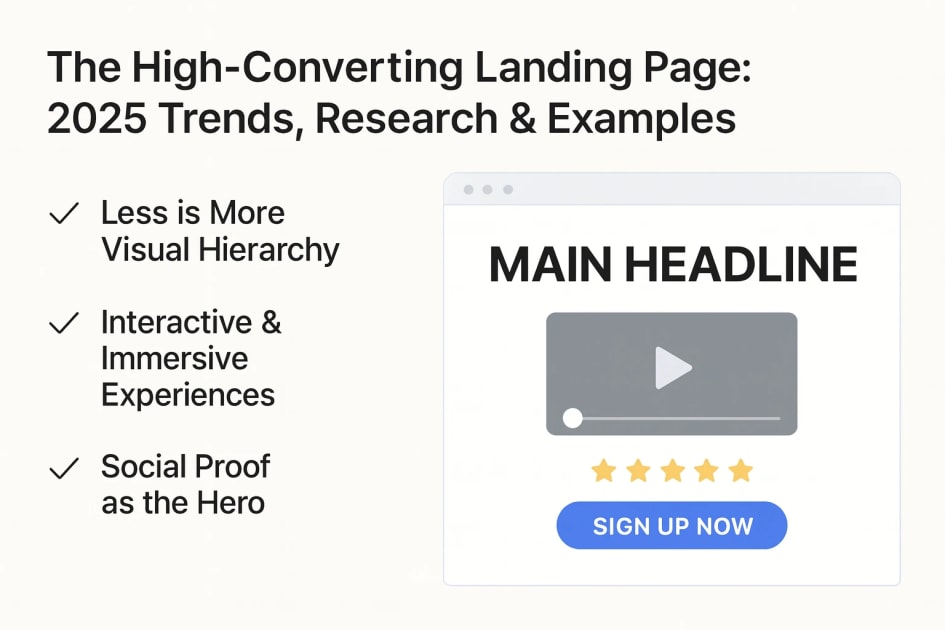
1. "Less is More" Visual Hierarchy
Research from industry leaders like Unbounce and HubSpot consistently shows that clarity always wins over excessive creativity. In 2025, the focus is on radical minimalism – stripping away anything that distracts from your core message. This approach is based on the principle that a clear and concise message is more effective than a cluttered and confusing one. By eliminating unnecessary elements, you can guide the visitor's attention towards the most important aspect of your landing page: the call to action.
- The Trend: "One Page, One Goal." Every element should guide the visitor towards a single, desired action. This could be filling out a form, making a purchase, or downloading a resource. The key is to make sure that every element on the page supports this goal.
- Best Practice: Consider removing the header navigation. Recent A/B testing data suggests that eliminating navigation links can boost conversion rates by as much as 100%! Why? Because it keeps visitors focused on the task at hand. When you remove the navigation, you're reducing the number of options available to the visitor, which can help to reduce friction and increase the likelihood of conversion.
- Research: According to Unbounce's conversion benchmark report, the median landing page conversion rate across all industries is around 6.6%. To surpass this benchmark, you need to minimize cognitive overload and make the decision-making process as easy as possible. This can be achieved by using clear and concise language, reducing the number of form fields, and using social proof to build trust with your visitors.
1.1 Implementing Radical Minimalism
To implement radical minimalism on your landing page, start by identifying the core message you want to communicate. What is the primary goal of your landing page? What action do you want visitors to take? Once you have a clear understanding of your goal, you can start to eliminate any elements that don't support it. This could include removing unnecessary images, reducing the amount of text, and simplifying your forms.
2. Interactive & Immersive Experiences
Static images are becoming a thing of the past. Today's users expect to actively engage with your content before making a purchase decision. They want to experience the value firsthand. Interactive elements such as calculators, quizzes, and demos can help to increase engagement and conversion rates. By providing an immersive experience, you can help visitors to better understand your product or service and how it can meet their needs.
- The Trend: Think calculators, quizzes, interactive demos, and "try-before-you-buy" code editors. These types of interactive elements can help to educate visitors about your product or service and provide a sense of hands-on experience.
- Best Practice: Interactive content generates 2x more conversions than passive content, according to Kapost. Give your audience something to do. This could be as simple as a quiz or as complex as a fully functional demo. The key is to provide an experience that is engaging and relevant to your visitors.
2.1 Creating Interactive Content
To create interactive content, start by identifying the types of interactions that are most relevant to your product or service. For example, if you're selling a software product, you might create a demo that allows visitors to try out the product before buying. If you're selling a physical product, you might create a quiz that helps visitors to determine which product is best for them. The key is to provide an experience that is engaging and relevant to your visitors.
When creating interactive content, it's essential to consider the user experience. Make sure that the interaction is easy to use and understand, and that it provides a clear benefit to the visitor. You should also test your interactive content to ensure that it is working as intended and that it is providing the desired outcome.
3. Social Proof as the Hero
In 2025, trust is the ultimate currency. Forget generic 5-star badges; authentic, detailed case studies and compelling video testimonials are taking center stage. Social proof is a powerful tool for building trust with your visitors and increasing conversion rates. By showcasing real-life examples of how your product or service has helped others, you can help to establish credibility and build trust with your visitors.
- The Trend: Embedding raw, user-generated video content (UGC) directly near the Call to Action (CTA). Let your customers speak for you! User-generated content is a powerful form of social proof, as it provides a firsthand account of how your product or service has helped others.
3.1 Leveraging User-Generated Content
To leverage user-generated content, start by identifying your most satisfied customers. These are the customers who have achieved the most success with your product or service and are most likely to provide a positive testimonial. You can then ask these customers to provide a video testimonial or case study that showcases how your product or service has helped them. This content can be used on your landing page to provide social proof and build trust with your visitors.
According to a study by BigCommerce, user-generated content can increase conversion rates by up to 18%. This is because user-generated content provides a level of authenticity and credibility that is hard to achieve with traditional marketing methods.
Real-World Examples (And Why They Work)
Let's explore three industry-leading examples that perfectly embody these principles. Get ready to be inspired! These examples demonstrate how to apply the trends and best practices outlined above to create a high-converting landing page.
1. Airbnb Hosts (The "What's in it for me?" Calculator)
Airbnb's landing page for attracting new hosts is a masterclass in personalization. Instead of a generic headline like "Become a Host," they leverage geolocation to show you exactly how much money you could earn in your specific city. It instantly addresses the user's primary concern: "Is it worth my time?"
- Why it works: The dynamic earnings calculator – a powerful tool that speaks directly to the user's potential ROI. This interactive element provides a personalized experience and helps to build trust with the visitor.
- Key Feature: The dynamic earnings calculator – a testament to their commitment to providing a personalized experience. This calculator is a great example of how interactive content can be used to educate visitors and provide a sense of hands-on experience.
- Link: Airbnb Host Landing Page
2. Shopify (Radical Simplicity)
Shopify's dominance is partly due to its ability to eliminate friction at every step of the user journey. The page is characterized by abundant whitespace, creating a clean and uncluttered experience. The headline focuses on the benefit ("Build your dream business"), and the form requests only one piece of information: your email address. No credit card details, no name, just pure simplicity.
- Why it works: The single-field entry form – a testament to their commitment to minimizing friction. By reducing the number of form fields, Shopify makes it easy for visitors to get started and reduces the likelihood of abandonment.
- Key Feature: The single-field entry form – a great example of how to simplify the user experience and reduce friction. This approach can be applied to any landing page to increase conversion rates and improve the overall user experience.
- Link: Shopify Free Trial Page
3. Codecademy (Interactive "Show, Don't Tell")
Codecademy doesn't just claim to teach coding; they empower you to start writing code immediately. The hero section often features a typing animation or a live code block that you can interact with directly. This taps into the user's desire for immediate skill acquisition and provides instant gratification.
- Why it works: The immersive hero section that mirrors the product interface, offering a taste of the learning experience. This interactive element provides a hands-on experience and helps to build trust with the visitor.
- Key Feature: The immersive hero section – a great example of how to provide an interactive experience and educate visitors about your product or service. This approach can be applied to any landing page to increase engagement and conversion rates.
- Link: Codecademy
Summary of Global Benchmarks (2025)
Here's a quick snapshot of key landing page performance metrics:
| Metric | Benchmark / Insight | Source & Year |
|---|---|---|
| Average Conversion Rate (Median) | 6.6% median conversion rate across industries | Unbounce Conversion Benchmark Report (2025) |
| Top-Performing Industry | Media & Entertainment achieves up to 12.3% conversion rates | Unbounce / WordStream (2024–2025) |
| Video Usage Impact | Landing pages with video record up to +86% conversion lift | EyeView Digital Study (2024) |
| Page Load Time Impact | Pages loading within 0–4 seconds show the highest conversion rates | Google & Industry Performance Studies (2024–2025) |
According to industry reports, the average conversion rate for landing pages is around 6.6%. However, this can vary depending on the industry and the quality of the landing page. The top-performing industries, such as media and entertainment, can achieve conversion rates of up to 12.3%. The use of video on landing pages can also have a significant impact, with some studies showing an increase in conversion rates of up to 86%. Finally, the load time of a landing page can also have a significant impact, with pages that load in under 4 seconds achieving the highest conversion rates.
🎯 Key Takeaways
- Focus on radical minimalism to simplify the user experience and increase conversion rates.
- Use interactive elements, such as calculators and quizzes, to educate visitors and provide a sense of hands-on experience.
- Leverage user-generated content to build trust and credibility with your visitors.
- Optimize your landing page for conversion by using clear and concise language, reducing friction, and providing a personalized experience.
Frequently Asked Questions
What is the average conversion rate for landing pages?
The average conversion rate for landing pages is around 6.6%, according to Unbounce's conversion benchmark report.
How can I improve the conversion rate of my landing page?
You can improve the conversion rate of your landing page by focusing on radical minimalism, using interactive elements, leveraging user-generated content, and optimizing for conversion.
What is the impact of load time on landing page conversion rates?
Pages that load in under 4 seconds achieve the highest conversion rates, according to Portent.
Sources & References
- Unbounce - Conversion Benchmark Report
- HubSpot - State of Marketing Report
- Kapost - Industry Report
- BigCommerce - Industry Report
Methodology: This article synthesizes information from industry reports, platform documentation, and our agency's direct experience managing digital campaigns in the UAE and GCC region.
Get Started with High-Converting Landing Pages
Optimize your landing page for conversion and increase the effectiveness of your marketing campaigns. Contact us to learn more about how we can help you create high-converting landing pages.
Get Free ConsultationLast reviewed: March 2025. This article is regularly updated to reflect the latest industry developments and platform changes.