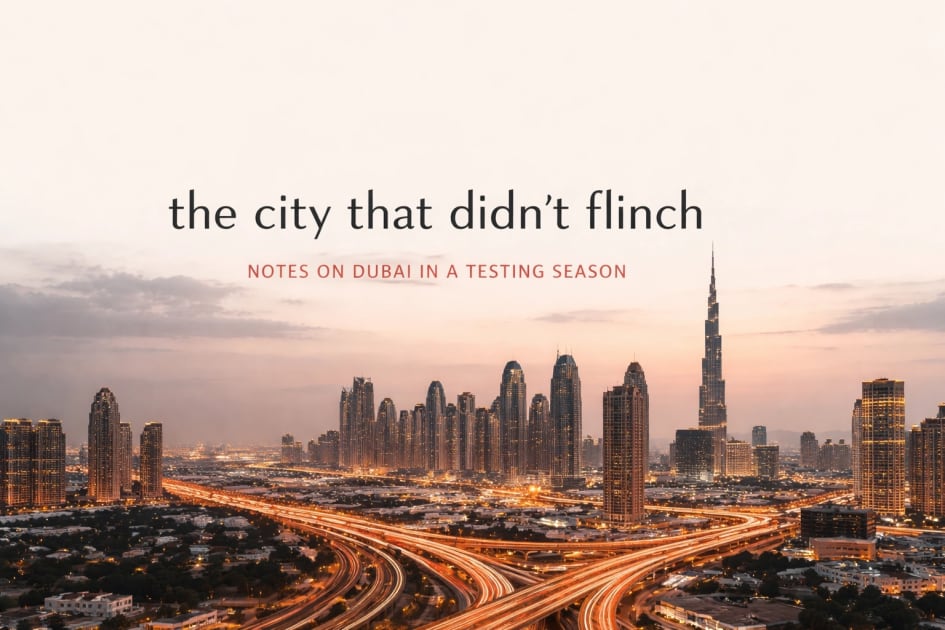
The City That Didn't Flinch: Notes on Dubai in a Testing Season
Insights
In a world defined by volatility, the true measure of a city is not its boom-time growth but its behavior under pressure. For Dubai, a global hub built on a foundation of diversity and trade, a recent period of regional uncertainty served as a critical test. This wasn't a test of physical infrastructure, but of its social and economic architecture—the underlying systems and human connections that hold a city together when external forces push on its seams.
The prevailing narrative often focuses on grand announcements and economic indicators. However, the more meaningful story lies in the smaller, almost invisible actions taken by individuals, businesses, and government entities working in concert. During this testing season, Dubai demonstrated a unique brand of resilience, characterized by rapid institutional response, proactive private sector engagement, and a profound sense of community cohesion that transcended nationality.
This analysis examines how Dubai navigated this period, highlighting the specific policies, private sector initiatives, and community behaviors that defined its response. We explore how a city of over 200 nationalities functioned not as a collection of strangers, but as a neighborhood, revealing a playbook for stability that goes beyond traditional crisis management.
The Social Fabric of Resilience: Community and Connection
In most cities, moments of stress cause a social fracture. Communities retreat into themselves, suspicion replaces trust, and the social fabric thins. Dubai's experience suggested the opposite. The most telling stories from this period were not about grand gestures, but about small acts of neighborly support that demonstrated a deep-seated social capital.
Consider the story of a 13-year-old girl in Dubai Silicon Oasis. With her father stranded overseas due to flight disruptions, she found herself at home with only her nanny. Within hours, neighbors she barely knew, residents from a different building, offered her a place to stay. As a Hungarian resident explained to Gulf News, the goal was simply "so she could be with more children her age for comfort." This act, simple and unprompted, defines how a city's residents behave when uncertainty arises. It highlights a community where hundreds of thousands of people, who arrived as strangers, have, over time, become neighbors.
This phenomenon was amplified through digital channels. In Al Furjan, a neighborhood WhatsApp group—typically used for mundane matters like parcel notifications and pool maintenance updates—transformed into a community lifeline. Residents shared grocery offers, offered updates on who needed assistance, and passed along information with small acts of trust. Similarly, in The Greens, Zanofer Fathima, a filmmaker raising two children alone, found herself leaning on neighbors she had previously only nodded to in the lift. "These groups have become my lifeline," she told Gulf News, emphasizing the invaluable sense of belonging when extended family is far away.
These anecdotes illustrate a crucial point: Dubai’s resilience is not solely a top-down phenomenon. It is built from the ground up, sustained by a network of community support that has matured over years of shared residency. The city's social infrastructure proved as robust as its physical infrastructure.
Proactive Governance and Economic Policy in Crisis
While community actions provided immediate support, Dubai's government demonstrated institutional capacity by moving swiftly to stabilize the economy. On 31 March 2026, the Crown Prince of Dubai, Sheikh Hamdan bin Mohammed bin Rashid Al Maktoum, announced an AED 1 billion support package. This was not a rescue operation for an economy in freefall, but rather a pre-emptive move to protect businesses and families from potential fallout.
The measures were substantial and targeted. They included three months of deferred government fees for hotels and tourism operators, extended customs grace periods for traders, fast-tracked residency renewals for employees and their families, and relief for businesses in both mainland and free zones. The context for this action is critical: Dubai's economy had posted strong growth, reaching AED 937 billion in 2025 with a 5.4% growth rate in 2025. The support package was a choice—a decision to give small businesses room to breathe without resorting to staff cuts or closures.
Sheikh Hamdan's statement on X underscored the city's commitment: "Dubai remains committed to supporting individuals, families and businesses with confidence and stability." This proactive approach, where policy decisions happen at the speed events demand, is a hallmark of Dubai’s governance model. It contrasts sharply with systems where support packages are delayed by parliamentary debate or bureaucratic inertia. The speed and scope of the package signaled a clear intention to protect the gains made and maintain business confidence during a period of uncertainty.
The Private Sector's Role: Beyond Compliance
The deeper story of Dubai's response lies in the actions of the private sector, which frequently moved in step with—and often ahead of—government announcements. This demonstrated a level of corporate social responsibility and community alignment that went beyond mere compliance.
In the holiday rental community, for example, hosts began voluntarily lowering prices and waiving fees for stranded travelers before formal directives were issued. Ramneek Singh Dhir, chief executive of the rental platform Livjaza, told The National that "across the Emirates, hosts immediately lowered prices, offered flexible check-ins and opened their doors to stranded travellers." Several hundred travelers were assisted this way, demonstrating a collective commitment to supporting the city's visitors. This behavior highlights a key aspect of Dubai's operational environment: a strong sense of shared responsibility between public and private stakeholders.
Similarly, Majid Al Futtaim, a conglomerate behind major retail destinations like Mall of the Emirates and Carrefour, launched the "Ma'an" initiative. This program offered free pop-up retail space and digital promotion to homegrown SMEs during the testing period. Khalifa Bin Braik, CEO of Majid Al Futtaim Asset Management, explained the rationale to The National: "We have seen that these businesses need help now more than ever, so we decided this was the best time to show up for the community that has always supported us." This pattern—the government acts, and the private sector anticipates and amplifies that action—is a defining characteristic of Dubai's resilience model.
The Quiet Economics of Keeping People Working
One specific measure from the AED 1 billion support package—the deferral of the Tourism Dirham for three months—provides a powerful example of how a technical policy decision protected the city's human core. To understand its impact, one must consider the demographic makeup of Dubai's workforce.
Dubai's hospitality sector employs a vast and diverse workforce, with staff from countries like the Philippines, India, Bangladesh, Nepal, Kenya, and Uganda. These individuals send remittances home that are vital to their families and, collectively, significant to their home economies. For example, remittances account for approximately 26% of Nepal's GDP and 7.3% of the Philippines' GDP, according to various economic reports. When hotel occupancy drops, the first line item on an executive's spreadsheet to face scrutiny is often payroll.
The Tourism Dirham deferral—a per-room, per-night levy—was, in practical terms, a decision to subsidize hotels to keep their staff employed. This policy ensured that the grandmother in Kerala received her son's remittance on time in March, and the family in Manila had a daughter who kept her hospital job in Dubai without interruption. These are not abstractions; they are the real human shape of what that policy protected. Daffodils Guevarra, a Filipina doctor working in Dubai, told NPR that even in uncertain days, she did not regret her choice to move: "Many migrant workers have made the region their second home." This demonstrates how smart policy decisions can safeguard both the local economy and the global remittance network that relies on it.
A City of 200 Nationalities, Behaving Like a Neighborhood
Mina Al-Oraibi, editor of The National, highlighted Dubai's unique foundation in TIME: "Dubai was built on migration, cultural fluidity and globalization. Those founding principles will keep powering its ambition." With a population drawn from roughly 200 nationalities, Dubai represents one of the most diverse social experiments in the world. The remarkable aspect of its response during this testing season was not merely that it happened, but that its foundational diversity held firm.
In a region where historical fault lines could easily resurface during stress, Dubai did what it has always done: it treated all its residents as residents. Hadi Badri, chief executive of the Dubai Economic Development Corporation, publicly noted in Washington that Dubai's half-million-strong Iranian community remained "still there... still participating in the economy. They're still safe." This commitment to inclusion, even during times of heightened regional tension, is a powerful demonstration of soft power as behavior, rather than just as a slogan. The city's ability to maintain social cohesion among diverse communities during stress is perhaps its greatest strength, ensuring that the architecture of daily life remains stable.
Key Takeaways from Dubai's Playbook
The word "resilience" implies recovery from damage. What Dubai demonstrated was something different: a system designed to function under pressure, not merely to survive it. The core elements of this playbook offer valuable insights for global cities aiming to build sustainable stability:
| Element of Resilience | Dubai's Approach | Impact on Stability |
|---|---|---|
| Infrastructure for Redundancy | Multiple ports, airports, and airline networks (e.g., Jebel Ali Port, Dubai International Airport, Al Maktoum International Airport). | Ensures no single choke point becomes fatal to trade or travel; maintains logistical flexibility during disruptions. |
| Institutional Capacity | Financial regulators and government bodies with authority to issue support packages and defer fees in days, without lengthy legislative processes. | Allows for rapid, targeted economic intervention; maintains business confidence by eliminating bureaucratic delays. |
| Social Capital and Community Cohesion | Proactive community support (e.g., WhatsApp groups, neighbors helping neighbors) and private sector initiatives (e.g., Ma'an program, rental fee waivers). | Transforms a "city of strangers" into a "city of neighbors," providing a bottom-up support network that complements top-down policy. |
Note: Data compiled from industry sources. Actual results vary.
A city does not produce these stories by accident. It produces them by having built, over many years, the kind of relationships among its residents and institutions that bear weight when asked to. The city that emerges from this testing season is recognizably the same city—one where the architecture of daily life held firm because of thousands of decisions made by people whose names will never appear in a headline: the landlord who called, the neighbor who invited the teenager over, and the hotel GM who didn't cut payroll.
🎯 Key Takeaways
- Community First Response: Social cohesion acts as a critical first line of defense during uncertainty, often preceding official government action.
- Proactive Policy and Institutional Capacity: The speed and targeting of government support, like the AED 1 billion package, demonstrate the value of institutional capacity to act decisively.
- Public-Private Alignment: A resilient city model relies on a private sector that moves in concert with government policy, often anticipating needs and providing support without mandate.
- Human-Centric Policy: Economic policies, such as fee deferrals, should be designed to protect the most vulnerable segments of the workforce, ensuring stability for both local and global economies (e.g., remittances).
Frequently Asked Questions
How did Dubai's economy perform during the recent period of uncertainty?
Prior to the testing season, Dubai's economy showed strong growth, with a GDP growth rate of 5.4% in 2025. The government's response involved a proactive AED 1 billion support package to maintain momentum and confidence, rather than a rescue operation for a collapsing economy. This approach focused on protecting existing businesses and employment.
What specific policies did Dubai implement to support businesses and residents?
The government implemented an AED 1 billion support package, which included measures like deferring government fees for hotels and tourism operators for three months, extending customs grace periods for traders, and fast-tracking residency renewals for employees and their families. This aimed to reduce financial pressure on businesses and prevent layoffs.
How did the community and private sector respond to the challenges?
The community demonstrated strong social cohesion through informal support networks like WhatsApp groups and neighbors helping neighbors. The private sector acted proactively, with landlords calling tenants and rental platforms voluntarily lowering prices for stranded travelers. Major corporate entities, like Majid Al Futtaim, also launched initiatives to support SMEs.
How did Dubai's diversity factor into its response?
With over 200 nationalities, Dubai's diversity proved to be a source of strength, not fracture. The city maintained social cohesion and treated all residents equally, allowing communities to support each other without retreating into separate groups. This demonstrated a commitment to inclusion that stabilized the social fabric during uncertainty.
Sources & References
- Gulf News - Reports on community WhatsApp groups and neighborhood support during the period of uncertainty.
- The National - Coverage of Sheikh Hamdan's AED 1 billion support package announcement (March 31, 2026).
- The National - Reports on Majid Al Futtaim Ma'an SME programme and Livjaza's housing support for stranded travelers.
- TIME Magazine - Mina Al-Oraibi essay on Dubai's diversity and resilience.
- NPR - Migrant workers in the Gulf region, including interview with Daffodils Guevarra.
Methodology: This article synthesizes information from industry reports, news articles, and direct observations from the period of uncertainty, focusing on the socio-economic and community-level responses in Dubai.
Understand Global Market Dynamics
In a rapidly changing world, strategic planning requires deep insights into socio-economic trends and governance models. Our team provides comprehensive analysis to help you navigate complex environments.
Get Free ConsultationLast reviewed: April 2026. This article is regularly updated to reflect the latest industry developments and platform changes.